admin
If you have used ChatGPT, Claude, Gemini or any large language model, you have interacted with tokens every single time — even if you never heard the word before. Tokens are the fundamental building blocks that LLMs use to read, understand, and generate human language. Many new AI users treat tokens as just another technical buzzword, but understanding them completely changes how you craft prompts, manage AI costs, and avoid hitting conversation limits. This simple guide breaks down AI tokens in plain language, no advanced math or machine learning background required.
What Exactly Is an AI Token?
A token is a small chunk of text that an AI model treats as one single unit. Tokens are not exactly full words, and they are not just individual letters. They sit somewhere in between. A token can be a short complete word, a fragment of a longer word, punctuation, numbers, spaces, or even emojis.
For simple examples:
- Short common words like “cat”, “the”, “run” usually count as one token.
- Longer or rare words get split into multiple pieces. The word “unbelievable” might break into “un”, “believ”, “able”.
- Commas, periods, question marks, and spaces all count as separate tokens too.
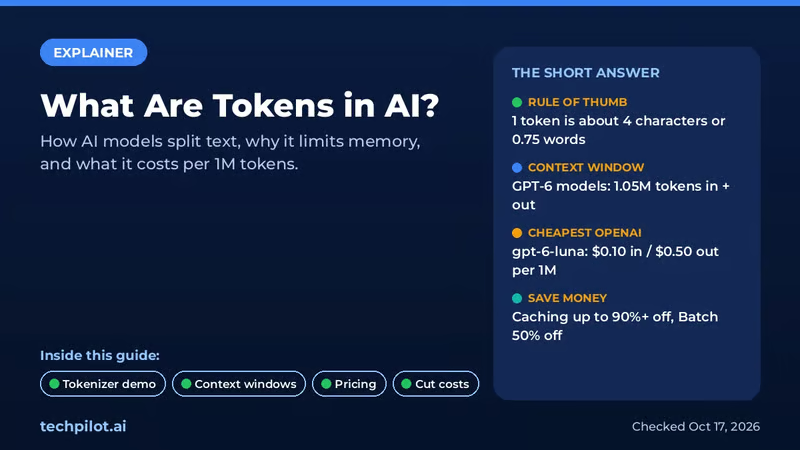
A handy rule of thumb for English text: roughly 1 token equals about 0.75 words, or around four characters. So 1000 English tokens are approximately 750 words. This estimate is not perfectly precise, but it works great for quick planning.
When you type a prompt into ChatGPT or Claude, a built-in tool called a tokenizer immediately cuts your text into these small chunks, then converts every token into a unique numeric ID. LLMs do not read sentences like humans. They only process lists of these numbers. Once the model finishes its calculation, it converts those numbers back into readable text for your screen. This whole process is called tokenization.
Why Do LLMs Use Tokens Instead of Just Words?
You might wonder why AI does not simply read text word by word. There are practical reasons behind this design. Human language has an infinite number of possible words, including new slang, technical jargon, product names, and made-up terms. If a model stored every single unique word in its vocabulary, the dictionary would become impossibly huge and inefficient.
By breaking text into sub-word tokens, LLMs learn smaller reusable text fragments. That lets them handle unfamiliar words by combining known pieces. For example, when the model meets a brand-new compound word it has never seen during training, it can still break it into familiar token parts and guess its meaning. This is why modern AI can adapt to new terms, code, and creative writing without constant retraining.
Tokenization also balances speed and memory. Processing thousands of individual letters would be far slower. Using full words would require an enormous vocabulary. Tokens hit the sweet spot for AI performance.
Tokens Are the Currency of AI: Pricing & Context Windows
The two most real-world impacts of tokens are API billing and context window limits. These are the two reasons every AI user should understand tokens in 2026.
1. Token pricing for AI APIs
When developers integrate models like ChatGPT or Claude into apps, they pay based on token usage. There are two categories: input tokens (your prompt, the text you send to AI) and output tokens (the response text the AI generates for you). In most cases, output tokens cost more than input tokens, since generating new text requires more GPU computing work.
For casual users on monthly subscription plans, token limits are often hidden behind message caps. But if you build AI tools, run bulk content generation, or use API services, token count directly controls your bill. Longer prompts, past conversation history, and large code files all consume more tokens and raise costs.
2. Context window: how much the AI can “remember”
Every LLM has a maximum context window, measured in tokens. This number defines the total amount of text the model can keep track of within one conversation. It includes your original question, all previous chat messages, uploaded documents, and the AI’s replies.
Once your conversation exceeds the token limit, the model loses access to the earliest parts of the chat. It will forget earlier instructions, background context, or details from documents you uploaded. This is a common frustration. Many users wonder why the AI ignores earlier requests in a long chat — they have simply hit the token cap.
Models in 2026 offer vastly larger context windows than just a few years ago. Some Claude variants can handle hundreds of thousands of tokens, enough to process entire books or full code repositories in a single prompt. But no model has unlimited context. Tokens always set the boundary.
How Token Count Changes Your Prompt Writing
Knowing how tokens work helps you write better, cheaper prompts. Here are practical tips:
- Remove redundant text. Repeating instructions every time wastes tokens and increases cost.
- Keep background context concise. Only paste reference material that the AI truly needs to complete the task.
- When uploading long documents, trim irrelevant sections. Extra paragraphs eat into your context window.
- If you hit memory loss in a long chat, start a fresh conversation to reset the token counter.
For developers working with code, note that programming source code usually consumes more tokens than plain English prose. Symbols, brackets, variable names, and line breaks all get tokenized separately. Pasting large code blocks can burn through your token budget much faster than regular text.
Common Misconceptions About AI Tokens
Let’s clear up some widespread misunderstandings:
- Myth: Tokens are the same as words. False. One long word can split into multiple tokens. One token can also be punctuation or a single character.
- Myth: Longer prompts always get better results. Not true. Extra fluff consumes tokens and can dilute your core instruction. Clear, concise prompts often outperform bloated ones.
- Myth: All tokenizers work identically across models. No. ChatGPT, Claude, and Gemini each use their own tokenizer. The same paragraph will produce slightly different token counts on different AI platforms.
- Myth: Tokenization only applies to text. For multimodal models, images are converted into special visual tokens, too. Image prompts also consume your token budget, even though you do not type any words.
Real-World Use Cases
Token awareness benefits different groups in different ways.
- Content creators: Trim prompts to reduce cost and avoid hitting chat limits when writing long articles.
- Software developers: Estimate API expenses before building AI features and manage long code inputs.
- Business teams: Upload reports, contracts and meeting transcripts while staying inside context limits.
- Casual users: Understand why AI forgets earlier details after a very long chat.
Final Thoughts
Tokens are not some mysterious AI secret. They are simply the standardized text chunks that large language models use to read and write. Tokens control what your AI can remember, how much you pay for API access, and how efficiently your prompts run.
In 2026, as more people build custom AI workflows, agents, and document analysis tools, token literacy becomes more valuable than ever. You do not need to master every detail of tokenization to use AI day-to-day. But a basic grasp of tokens will help you write sharper prompts, manage costs, and avoid the common pitfall of running out of context in long conversations.
Next time you send a prompt to ChatGPT or Claude, remember: you are not just sending words. You are sending tokens, the hidden building blocks behind every AI response.